


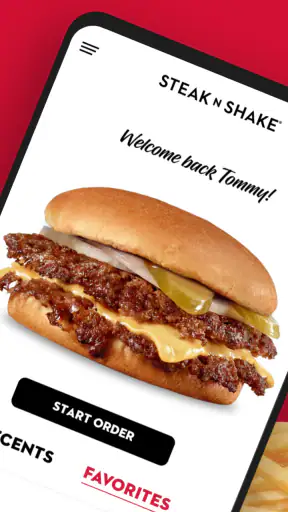
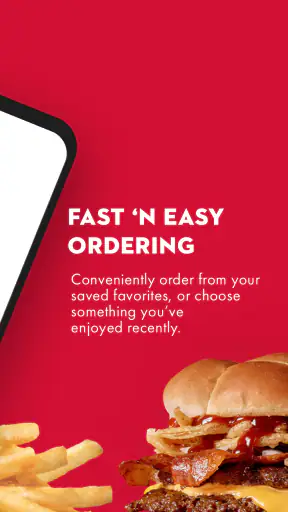
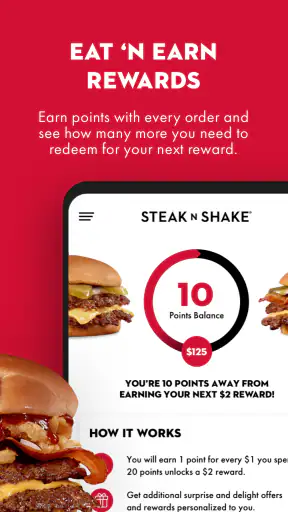
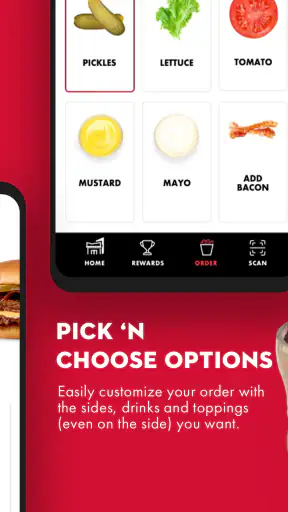
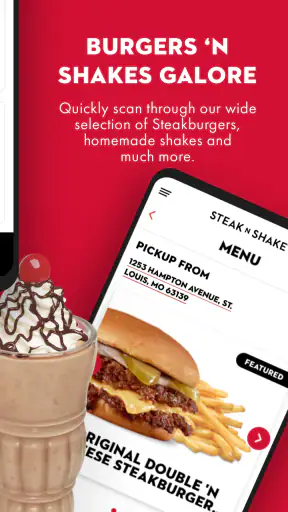
I found Steak 'n Shake useful for a very specific kind of food order: the meal I already know I want, placed before I arrive. It is a free Food & Drink app from Steak 'n Shake Enterprises, built around ordering ahead and collecting points through pickup, delivery, or the restaurant’s Car Hop option. In my experience, that focus makes it more practical than a general restaurant-discovery app when I am already thinking about a Steak 'n Shake meal, but less useful when I am comparing many restaurants or trying to discover somewhere new.
The app has been available since November 6, 2012, and its current version is 4.9.0. It is suitable for Everyone and works on devices running Android 7.0 or later. Its 4.5 average from around 13 thousand ratings, together with more than a million installs, suggests that it has found a steady audience, although those figures alone do not tell me whether every location offers the same ordering experience. Restaurants can differ in hours, menu availability, pickup arrangements, and delivery coverage, so I treat the app as a convenient ordering tool rather than a guarantee that every option will appear everywhere.
What the app is really for
The central idea is simple: choose food in the app, select how you want to receive it, and avoid placing the entire order at the counter. That sounds ordinary, but the useful part is the combination of ordering ahead and points. If I am stopping at Steak 'n Shake on the way home, I can make the decision before I leave rather than standing in line while deciding between a burger, fries, shake, or another menu item.
There are several distinct situations here. Pickup suits someone passing a restaurant and wanting to reduce waiting. Delivery is more convenient when leaving home is the problem, though it also depends on the address and the delivery choices shown at the time. Car Hop is the most distinctive option because it is aimed at receiving an order without following the usual dine-in or counter-pickup routine. I would check the available instructions carefully before relying on it, especially if I am visiting an unfamiliar location.
The points system is another reason to use the official app instead of ordering casually every time. I would not choose a restaurant solely because an app has rewards, but regular Steak 'n Shake customers can benefit from keeping orders in one place. The important practical question is whether I will order often enough to care about tracking points. Occasional visitors may find the extra account step less worthwhile than simply ordering in person.
The strongest reason to install it is repeat convenience, not restaurant discovery. This is not the app I would open to browse a whole city’s food scene. It is the app I would open after deciding that I want Steak 'n Shake and wanting a clearer path from menu choice to collection or delivery.
A realistic weekday use case
Imagine I am leaving work later than planned and want dinner ready around the time I reach home. I can open the app, select a nearby restaurant, review the available menu, and choose delivery if that location supports it. If delivery is not suitable, I might switch to pickup and collect the order on my route. That flexibility is more useful than it first appears: the best option may change depending on traffic, weather, whether I am already driving past the restaurant, and whether I need food for one person or several.
For a family order, I would build the basket slowly rather than rushing through it at the counter. This gives me a chance to check each item, catch an unwanted modification, and decide whether a shake or side is actually needed. I would still review the final order before submitting it. Ordering ahead reduces one kind of friction, but it can also make mistakes easier to overlook if I tap through too quickly.
Trust starts with clear choices
Because this app handles food orders and may involve an account, location selection, and payment-related steps, I pay attention to what the screen asks me to do rather than assuming convenience is the whole story. A trustworthy ordering experience should make the selected restaurant, order method, basket contents, and final confirmation understandable before I commit. I prefer to pause at each of those points instead of treating the app like a one-tap shortcut.
I also separate what I can directly control from what happens behind the scenes. I can choose whether to place an order, select pickup, delivery, or Car Hop when those options are offered, and decide whether earning points is worth using the account features. Those visible choices matter. They let me use the app for a single order without pretending that rewards or saved details are mandatory parts of the experience.
At the same time, I would read any permission request and account prompt in context. The app’s purpose does not automatically mean every permission is necessary for every task. If I am only browsing a menu, I would not rush to grant access that does not appear relevant to that moment. If a feature needs a particular setting, I want the reason to be apparent on screen and the choice to remain mine.
Account controls and the points trade-off
Points can make ordering feel more rewarding, but they also create a reason to keep using an account instead of ordering anonymously or at the restaurant. My advice is to decide based on your habits. If you visit often, an account may be worthwhile because it keeps rewards connected to your orders. If you order only once or twice, the benefit may not justify remembering another login or maintaining another restaurant profile.
I would also avoid treating a points balance as a discount until the app clearly shows how it can be used. Rewards programs often have conditions, and the practical value depends on the choices presented during checkout. The sensible workflow is to check the balance and any available redemption option before finalizing the basket, rather than adding food solely to reach a target that may not suit the meal.
Another small but useful habit is to review the account area periodically. I would check whether my contact details are still correct, whether an old restaurant location is selected, and whether I still want any saved ordering preferences. This is not exciting, but it reduces the chance of sending an order to the wrong place or continuing to use settings that no longer fit my routine.
Where personal information becomes more sensitive
The most data-sensitive moments are the practical ones: choosing a location, arranging delivery, signing into an account, and completing an order. A pickup order may only need a restaurant selection and order details, while delivery naturally involves an address and instructions. I would choose the least complicated method that solves the problem. If I am already driving past a restaurant, pickup may be preferable to sharing delivery details for a meal I can collect myself.
Location access deserves the same measured approach. If I know which Steak 'n Shake I want, I would rather select it directly than enable location access just for convenience. If the app offers a location-based restaurant search, that can save time, but I would still consider whether the convenience is worth granting access at that moment. The important point is that a food-ordering app should be used deliberately: enable what helps with the task and review what you no longer need.
Notifications can also affect the experience. Order updates may be useful when I am waiting for delivery or trying to time a pickup, but promotional messages are a different matter. I would keep notifications that help me manage an active order and adjust the rest through the device or app settings if they become distracting. That gives me a way to preserve the functional benefit without allowing the app to dominate my phone.
I would apply similar care to payment. Before submitting, I would confirm the selected location, order type, items, modifications, and total shown by the checkout screen. This is especially important when switching between pickup and delivery because the practical cost and timing can change. I would not rely on memory from a previous order, since the available choices can depend on the restaurant and the current order method.
How it compares with ordering at the restaurant
Ordering in person still has advantages. I can ask a staff member a question immediately, see the situation at the restaurant, and change my mind without navigating an account or checkout flow. For a simple spontaneous visit, the app may add more steps than it removes. It also cannot solve a crowded restaurant, a missing menu item, or a location-specific issue that needs staff attention.
The app is better when I already know my order and want to prepare it before arrival. It is also more attractive for customers who value points or want to choose Car Hop, pickup, or delivery from one place. The trade-off is that digital convenience depends on selecting the right location and carefully checking the order. In-person ordering offers conversation and immediate clarification; the app offers preparation and a written basket to review.
How it compares with general delivery services
A general delivery platform is usually better for comparing multiple restaurants, checking several cuisines, or combining a broad search with delivery logistics. Steak 'n Shake’s own app is more focused. If I have already chosen the chain, the direct route can feel cleaner because I am not filtering through unrelated restaurants.
That focus can also be a limitation. I would not install it expecting a wide restaurant marketplace or a universal delivery solution. The useful comparison is not which app is universally best, but which decision I am making. For Steak 'n Shake pickup, points, or Car Hop, the official app is the logical first choice. For comparing nearby alternatives, a broader service or a map-based search may be more suitable.
Small workflows that make it easier to use
My first tip is to select the restaurant before spending too much time customizing the meal. The available order methods and menu choices can depend on the chosen location, so building a perfect basket and only then discovering that the desired method is unavailable wastes time. I would start with the restaurant, then the order type, then the food.
My second tip is to use pickup as a planning tool rather than assuming it means the food will be ready the instant I arrive. I would allow room for traffic and restaurant activity, then confirm the collection instructions. Car Hop deserves the same attention: I would read how the restaurant expects me to identify my arrival instead of pulling into a space and waiting without knowing what to do.
My third tip is to treat modifications as a final-check item. Digital menus make it easy to tap preferences, but a long order can hide one accidental selection. Before submitting, I would scan each item from top to bottom and confirm that the restaurant, pickup or delivery choice, and any special requests are correct. This takes less time than trying to fix an incorrect order after submission.
My fourth tip concerns rewards. I would check points after the order has been accepted and keep the confirmation available until the meal is complete. If the points matter to me, that simple habit gives me a record of the transaction and makes it easier to notice a problem early. I would not assume that a failed, canceled, or changed order will be handled exactly like a completed one without checking the app’s visible account information.
Who should use it and who should skip it
I would recommend it to regular Steak 'n Shake customers who want to order ahead, use pickup, try Car Hop, arrange delivery when available, or keep track of points. It is also a good fit for people who dislike deciding at the counter and prefer to review a basket privately before ordering. The Everyone age rating makes it broadly accessible, although younger users should still handle account and payment decisions with appropriate adult guidance.
I would skip it if I rarely visit Steak 'n Shake, dislike creating restaurant accounts, or mainly want to compare several nearby restaurants. I would also choose in-person ordering when I have a complicated question, need immediate staff assistance, or am already at the counter with no meaningful wait to avoid. The app is a convenience layer, not a replacement for every kind of restaurant interaction.
My cautious verdict
Steak 'n Shake is a focused ordering companion with the most value for repeat customers. I like that its purpose is easy to understand: prepare a Steak 'n Shake order, choose a practical way to receive it, and collect points when that fits my routine. Pickup and Car Hop make it more flexible than simply viewing a menu, while delivery covers the moments when going out is inconvenient.
My caution is equally straightforward. I would verify the selected location, order method, basket, and checkout details every time, and I would make deliberate choices about account access, permissions, notifications, and delivery information. The app earns trust through visible control rather than through convenience alone, so I would use only the features that solve my immediate need.
For me, this is worth keeping installed if Steak 'n Shake is a regular stop. It is free, mature enough to have built a substantial user base, and focused on a real everyday problem: getting a familiar meal with less counter-side waiting. If my needs are broader than that, a general food service or direct restaurant visit may serve me better. But for planned Steak 'n Shake orders, the app is a sensible tool as long as I stay attentive at the moments where personal details, payment, and order accuracy matter.


